4 min read
AI can copy your style. It cannot copy your seal.
A machine can now paint like you in seconds. So the old proof of authorship, being the only person who could make the work, is gone. Here is what replaces it, and what happened when I tried it with real artists in Abuja.
A machine can now paint in your style in about ten seconds. So the thing that used to prove a work was yours, that you were the only person who could have made it, is gone. That is not a small problem for an artist. It is the whole problem.
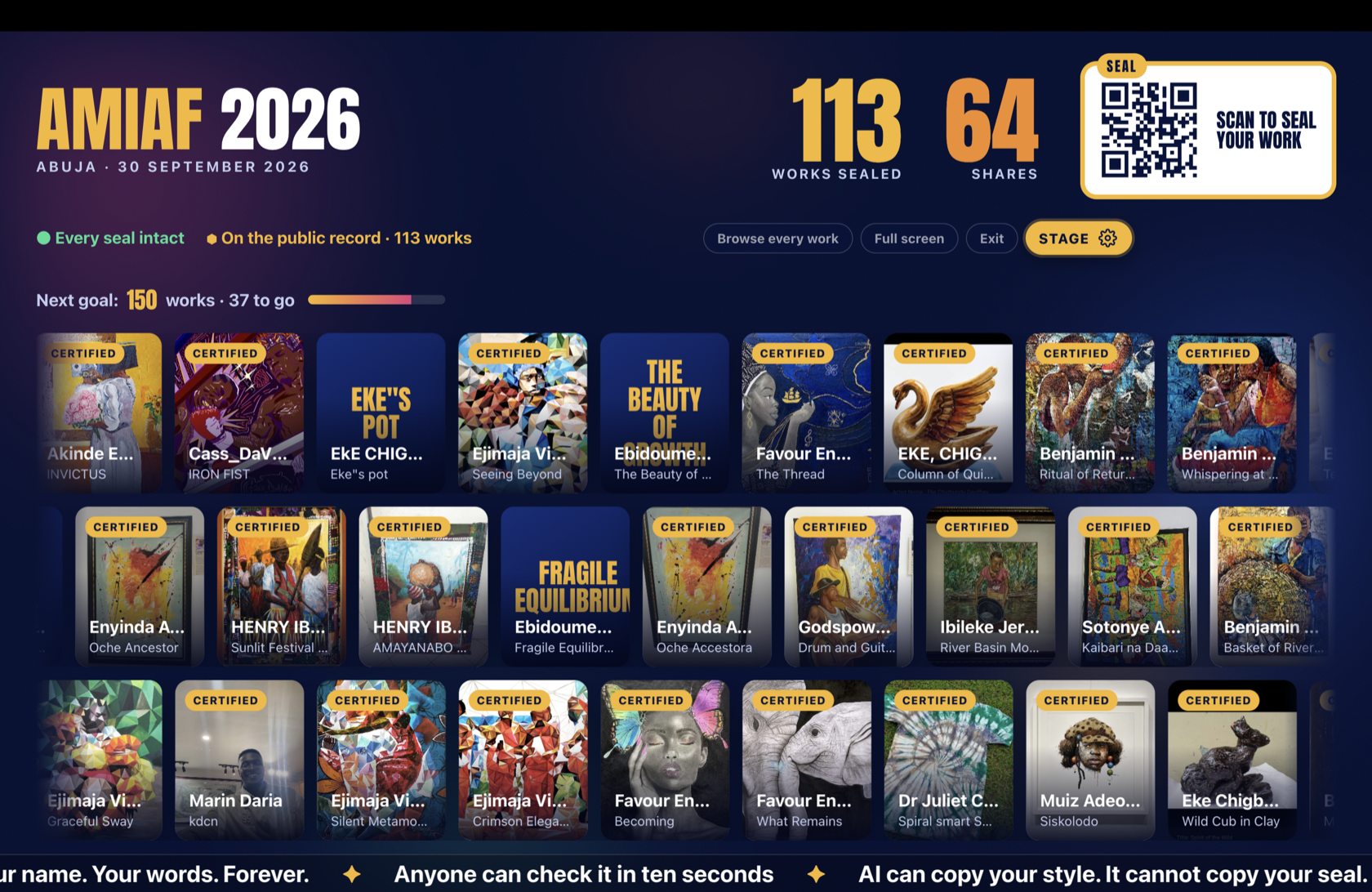
I took that problem to a room full of artists in Abuja. Not to argue about it. To test a fix. Every artist brought a real piece, made by hand, and we gave each one a seal: a photo, a fingerprint of that photo, and a line on a public record that nobody can quietly change later. Not the gallery. Not the artist. Not me. Especially not me.
More than a hundred works now carry a seal, and the number still goes up. Every seal is intact. Anyone with a phone can scan one and see who made the work, and when it was first put on the record. They do not have to trust the artist. They do not have to trust me. They check.
AI changed the question
For most of history, a style was a kind of proof. If a painting looked like your work, it was probably your work, because making it took your hand and your years. An image generator breaks that quietly. Feed it enough of someone and it will hand back a thousand pieces in their style by lunch. The look is no longer evidence of the maker.
Most of the panic about this is aimed at stopping the copying. That is a fight you lose. The copy is cheap and it is everywhere. The better move is to stop trying to make your style uncopyable, and make your authorship provable instead. Let anyone copy the look. Hold the proof of who made the original, and make that proof public and easy to check.
AI can copy your style. It cannot copy your seal.
What a seal actually is
There is no magic in it, and that is the point. We photograph the finished work. We run that photo through a one way function that turns it into a short string of characters, a fingerprint, where changing a single pixel changes the whole string. We write the fingerprint, the maker and the time onto a public record that is open for anyone to read and that nobody can rewrite. That is the seal. A copy of the painting will not match the fingerprint, and a changed record will not match the one already written. The check takes seconds and needs no expert.
Why I started with artists
Because they are the clearest case of a hole that is everywhere. An artist in Abuja cannot prove the painting is hers. A compliance officer in London cannot prove an AI agent was allowed to spend the money it spent. Different rooms, different decades, same hole: the thing happened and nobody can show it afterwards. The answer is the same in both. Not a louder claim. A receipt a stranger can check.
That is the work I keep doing, from a festival hall to a smart contract. Log what was done, prove it was not changed, and let anyone outside the system confirm it without asking you to trust you. In a year when AI can produce a convincing version of almost anything, that is the part that holds.
Your name, your words, your work. Anyone can check it in ten seconds.
So the question for anyone who makes something real, a painting, a photograph, a piece of writing, a decision: if a machine produced a perfect fake of it tomorrow, could you prove which one was yours? If the answer is no, you do not have a copying problem. You have a proof problem, and that one you can fix.
See the proof →The public record, the receipts, and what each one means. Open it and check it yourself.
O'Rume Dominic Uririe builds verification infrastructure for AI and blockchain systems. The measurement instrument is open source and the receipts library has no dependencies.